Skip to content
Home CaddieBuild My Setup

Home putting practice

Practise the problem.
Not just the putt.

Choose one weakness, use the smallest setup that gives honest feedback, and leave every session with a score.
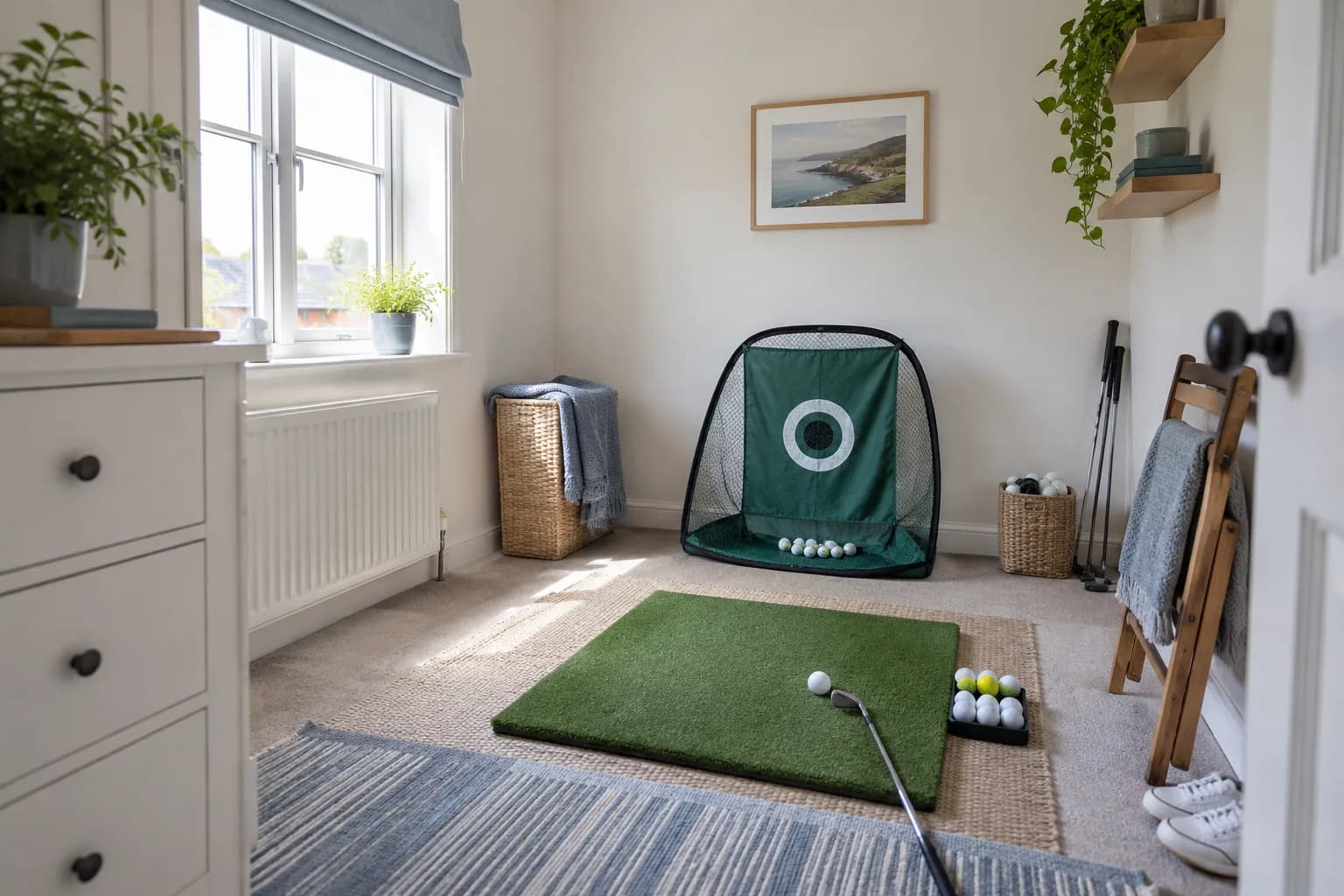
A compact putting practice setup in a home room
Illustrative Home Caddie scene

Diagnose before you buy

What keeps going wrong?

Do not try to fix line, pace and pressure in the same rep. Pick the row that most resembles your miss and practise that job for two weeks.

Putts start left or right

Start line

A straight floor line, one ball and your putter

Use the start-line block below. A mat adds repeatable markings, but is not essential.

Good line, poor distance

Pace

A flat 2–3m roll and three removable markers

Use the distance ladder. Longer clear space gives a wider range; it does not reproduce outdoor green speed.

Practice is good, pressure putts are not

Consequence

A target and a written make streak

Use the five-in-a-row block. A pressure trainer can make the target more demanding, but the score is the important part.

The room stops you practising

Fit and friction

Masking tape and ten minutes to measure

Start with the small-room guide before buying equipment.

Minimum before upgrade

Start with feedback, not equipment

No-buy setup

Flat floor + line + target

Enough to score start line and a short finish zone. Use removable tape safely and check that the ball cannot reach stairs, glass or a walkway.

Useful upgrade

A repeatable surface

A putting mat makes markings and roll more repeatable. Choose it by usable room and practice distance, not by the longest product that might fit once.

Measure a small room →

Target upgrade

Consequence and return

A pressure target or ball return can make repetition easier. It is worthwhile only when it supports the drill you will actually repeat.

Compare current putting options →

A scored 15-minute session

Three blocks. One number from each.

These blocks adapt established start-line, distance-control and streak drills into a compact home routine. Scores are Home Caddie practice rules, not performance promises.

  1. Start-line truth

    Find out whether the ball begins on the line you chose.

    Set up
    Use a straight printed line, ruler or narrow board aimed at a safe target. Start close enough that success is possible.
    Rule
    Roll 10 balls. Count one only when the ball stays on the line or board to its end. Do not count whether it finishes in a cup.
    Dose and score
    One set of 10. Record the score; beat your own baseline before making the task narrower or longer.
    Limitation
    This diagnoses start direction on a straight surface. It does not teach you to read break.
  2. Three-distance ladder

    Make one stroke task produce three clearly different roll lengths.

    Set up
    Mark three start points within the space you have and a finish zone about a putter-length deep. Keep the surface and target direction unchanged.
    Rule
    Roll one ball from near, middle and far. The ball scores only if it finishes inside the zone. Complete three ladders for nine putts.
    Dose and score
    Target six of nine in the zone. When you pass twice, make the zone smaller—not the room longer.
    Limitation
    The result belongs to this surface. Recalibrate on the practice green before a round.
  3. Five with consequence

    Give short-putt practice a finish line instead of endless repetition.

    Set up
    Choose a straight distance you can make often but not automatically. Use a cup, target or pressure trainer.
    Rule
    Make five in a row. A miss returns the count to zero. Stop after 15 attempts even if you have not completed the streak.
    Dose and score
    One attempt at the challenge. Record completed or not completed; do not move closer halfway through.
    Limitation
    A straight indoor streak creates focus, but cannot copy a sidehill putt or tournament pressure.

Make it repeatable

A simple week

  1. Session one: all three blocks; record line, pace and streak scores.
  2. Session two: repeat only your lowest-scoring block twice.
  3. Session three: repeat the full session without changing the setup.

Change one variable only after two comparable sessions. Otherwise a better score may reflect an easier task rather than better control.

Budget decision

Buy only after the routine survives

  • Spend nothing: when a safe flat roll and measurable target already exist.
  • Under £100 band: when repeatable markings or a demanding target removes friction.
  • £100–£250 band: when a longer integrated surface and return genuinely fit the room and routine.

These are stable planning bands, not current prices.

Transfer to the course

What the spare room cannot teach

Keep indoors

  • • repeated setup and routine;
  • • start-line feedback on a straight task;
  • • centred contact and defined roll-length tasks;
  • • a scored streak with a consequence for missing.

Recalibrate outdoors

  • • long-distance pace on the day’s green speed;
  • • uphill, downhill and sidehill putts;
  • • reading break, grain, moisture and changing surfaces;
  • • the relationship between intended line and required pace.

A home mat is a controlled feedback station, not a replica green. Before a round, learn that day’s pace and break rather than assuming an indoor roll transfers unchanged.

Continue the putting path

Make the next decision

Coaching sources

Checked 24 September 2026. Home Caddie adapted these established drill formats into the scored routine above; we have not physically tested the products discussed.

For product selection methodology, read how Home Caddie recommends.